

GETTING AROUND · 10 min
Bangkok by Train: the Fares, the Cards, and the 45 Baht Cap Due in January
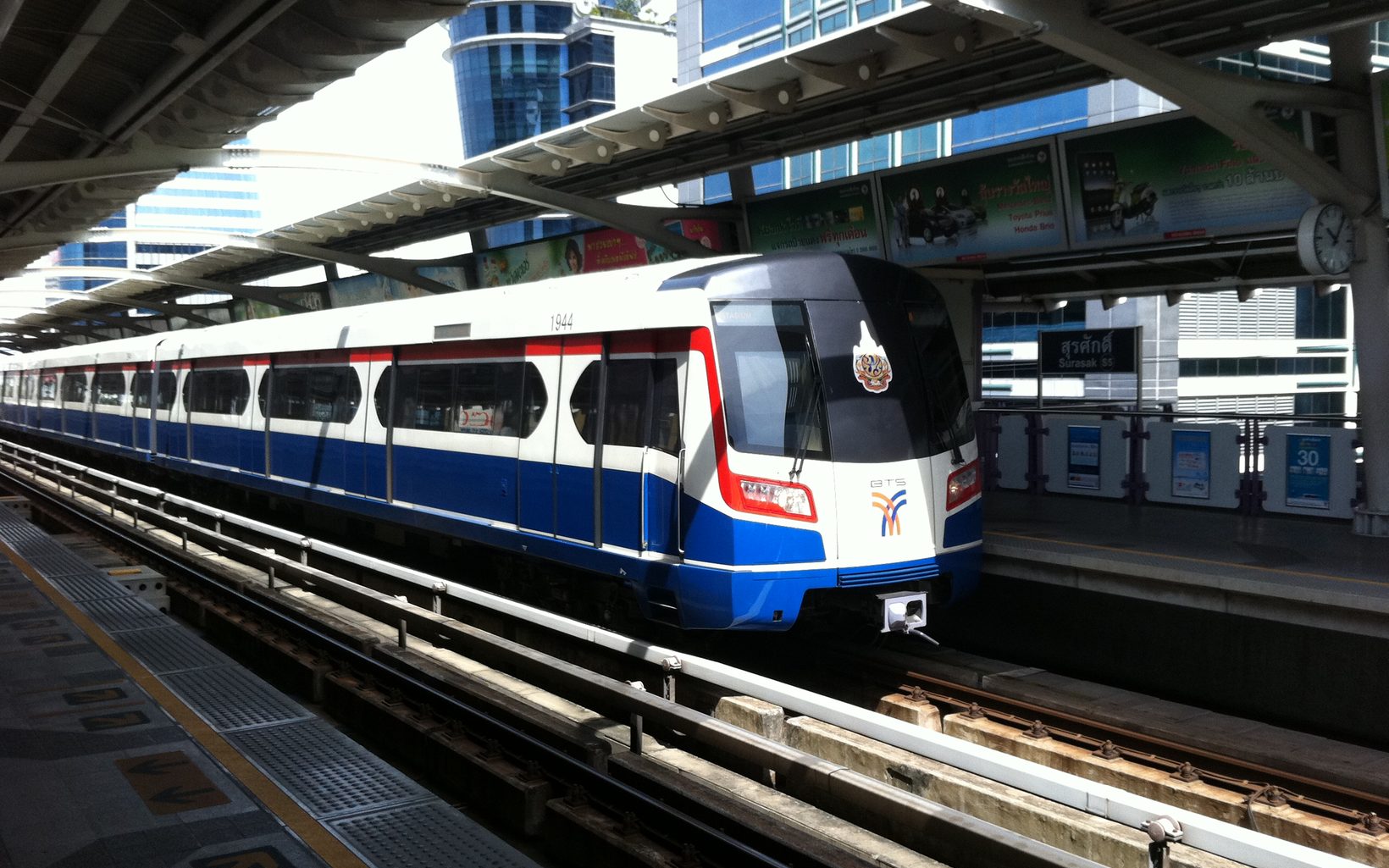
Bangkok’s rail network is run by several companies under two authorities, and the fare you pay depends on which of them owns the track under you. The government has spent three years trying to flatten that into one number. For a visitor, the important part is short: the cheap flat fare requires a Thai identity card, the cap that will not is due on 1 January 2027, and until then you pay each operator’s own rate.
The lines, and who runs them
- BTS Skytrain, the two elevated lines through the shopping and hotel districts: the Sukhumvit Line and the Silom Line. BTS’s own history page records no new station since Saint Louis opened on the Silom Line in February 2021.
- The Gold Line, 1.8 km and three stations from Krung Thon Buri across to Taksin Hospital, opened on 16 January 2021 and run jointly by the city, Krungthep Thanakom and BTS.
- MRT Blue Line, the underground loop through the old city and Chinatown. The Mass Rapid Transit Authority gives it as an original section of 18 stations over 20 km, plus an extension of 20 stations over 28 km, operated by Bangkok Expressway and Metro.
- MRT Purple Line, 16 stations over 22 km from Khlong Bang Phai to Tao Poon, mostly of use if you are staying in Nonthaburi.
- MRT Pink Line, a monorail of 30 stations over 34.5 km from the Nonthaburi civic centre to Min Buri, opened on 31 December 2023.
- MRT Yellow Line, the other monorail, down the eastern side of the city.
- SRT Red Lines, the commuter lines north and west from Krung Thep Aphiwat, which is also how you reach Don Mueang airport.
- The Airport Rail Link to Suvarnabhumi, covered in our airports guide, along with the Red Line’s airport stop.
What it costs
| Line | Fare | Source |
|---|---|---|
| MRT Blue Line | 17 to 44 baht, with 44 baht from 12 stations, since 3 July 2026 | News report, Thairath English |
| BTS Green Lines, extension only | From 17 baht, since 1 November 2025 | News report, The Nation |
| BTS Green Lines, main line plus extension | Capped at 65 baht a journey | News report, The Nation |
| SRT Red Lines | 12 to 42 baht for an adult, 1.50 baht a kilometre | The operator’s own fare page |
| Purple and Red Lines together | No more than 40 baht a day, to 30 November 2026 | The authority’s own announcement |
The daily cap is the one bargain open to everyone. The Mass Rapid Transit Authority set a maximum of 40 baht a day for the general public across the Purple and Red Lines from 1 December 2025 to 30 November 2026, and 30 baht a day for students. If the day’s real fares come to less, you are charged the real amount. It only works if you pay with a Mangmoom EMV card, an MRT EMV card or an EMV contactless bank card.
BTS fares are the gap here. The Skytrain publishes its fare table as an image its site would not render for us, so the only figures printed above are the ones in news reports of the November 2025 change. Expect a single journey across town to cost more than the MRT equivalent.
Why the 20 baht fare is not for you
Thailand has run a 20 baht flat fare since October 2023, when it started on the Purple and Red Lines. From 1 October 2025 the Cabinet extended it to 13 routes for one year.
The catch is in the conditions. The Government Public Relations Department’s own announcement limits the benefit to passengers holding a 13-digit Thai national identity number, registered through the government’s Thang Rat app and linked to an EMV bank card or a stored-value Rabbit card. A foreign passport does not qualify. If you have read elsewhere that Bangkok’s trains cost 20 baht to anywhere, that is the scheme being described, and it is not open to visitors.
The 45 baht cap, and what it changes
In June 2026 the Cabinet approved a different measure: a maximum fare of 45 baht a trip, which includes the 17 baht entry fee written into the old concessions, across every line in Bangkok and the surrounding provinces, with no second entry fee when you change from one operator’s line to another. Journeys costing less than 45 baht are charged at their real price. The resolution that set the 20 baht Phase 2 measure was revoked at the same time.
The department’s own page of 19 September 2026 says the equipment is still being installed and gives the expected start as 1 January 2027, paid for with EMV contactless cards. Nothing in either announcement limits it to Thai nationals, which would make it the first flat measure a visitor can use.
Two cautions. The regulation behind it is to be drafted by December 2026, and a news report of 16 September 2026 says the single-ticket scheme at 17 to 45 baht still had to go to Cabinet, with sign-off expected in November. Dates on Thai fare policy move. Check before you count on it.
How to pay
A foreign bank card is now the simplest option on most lines. A news report of 27 February 2026 lists EMV contactless as covering six lines: Red, Blue, Purple, Pink, Yellow and the Airport Rail Link. The same reporting says the Blue and Purple Lines stopped accepting the old stored-value cards on 1 June 2026 and went EMV only, and that a Visa, Mastercard or UnionPay card issued anywhere can be tapped straight in. The Yellow Line’s operator states the same in its own words: credit cards from any Thai or international issuer on Visa, Mastercard or UnionPay, and international debit cards on those networks.
The BTS is the exception. The Skytrain runs on the Rabbit card, and none of the sources we could read lists the Green or Gold Lines among the EMV lines. A new Rabbit card costs 120 baht as an issuance fee, with no deposit, and takes a minimum of 100 baht of value at a time, up to 4,000 baht. Top it up at BTS, Yellow Line, Pink Line or BRT ticket offices, or at a machine in any station.
The MRT’s own card, if you want one, costs 180 baht to start: a 50 baht refundable deposit, a 30 baht issuing fee and 100 baht of travel. It holds up to 2,000 baht, a credit-card top-up has to be 300 baht or more, and it is suspended after two years without use. Refunds under 299 baht are paid in cash at a station; 300 baht or more goes to a Thai bank account, which rules it out for most visitors.
Single journey tickets still exist on the BTS, bought at the machines. Its conditions say a single journey ticket expires at the end of that day’s service, and is refundable only if you never entered the paid area, or left it at the same station within five minutes.
Hours
The Pink Line’s page gives 06:00 to 24:00 daily. The Blue Line’s page gives its hours as “06.00 am - 12.00 pm”, which reads as noon and is almost certainly meant as midnight, so treat the Blue Line as running to roughly midnight rather than to a time we can quote. The Red Lines run from 05:00 to midnight, about every 10 minutes at peak, 15 to 20 off-peak, and up to 40 minutes on the Taling Chan branch. BTS does not publish its hours in a form we could read; its trains start earlier than the MRT in practice, but we are not printing a time we cannot source.
Rules worth knowing
- Tap out with the card you tapped in with. On the Yellow Line, failing to do so brings a penalty equal to the line’s maximum fare of 45 baht.
- No pets anywhere in the MRT system.
- Discount card types get checked. The Pink Line’s conditions require a student to show a student card and a citizen card on demand, so the adult rate is what a visitor pays.
- Trips loaded onto a Rabbit card are not refundable once they are on it, and BTS concessionary tickets cannot be exchanged for cash at all.
- Changing from the Blue Line to the Yellow Line at Lat Phrao within 30 minutes on the same EMV card earns a 15 baht discount on the Yellow Line’s entry fee, credited back to the card within days.
- Lifts. BTS asks passengers to take particular care of children, older and disabled passengers in its lifts, and several stations including Mo Chit, Siam, Asok, On Nut and Chong Nonsi have a call button beside the lift to reach staff.
Getting to the sights
The Blue Line is the one that reaches the old city: the authority’s route description runs it under Sanam Chai Road and beneath the river near Pak Khlong Talat, which puts Sanam Chai station at the Grand Palace and Wat Pho end of town, a walk that most visitors otherwise make by boat or taxi. The same line has a station called Chatuchak Park beside the weekend market, where the BTS also stops at Mo Chit.
For everything else, each of our Bangkok listings prints its own address and coordinates, and the operators’ route maps are the reliable way to match those to a station. We have not repeated the station-by-station lists that circulate elsewhere, because no official page we could read states them.
What is being built
The Purple Line’s extension from Tao Poon to Rat Burana is the one that will matter to visitors, since it runs into Thonburi. The authority’s own project page gives it as 23.6 km and 17 stations, civil works 67 per cent complete, and an expected opening of November 2030. Several published round-ups give around 17 km, 14 stations and 2027; those figures do not match the authority’s own page, and the authority’s is the one we follow.
What we could not confirm
- BTS’s own fare table, its Gold Line fare and its One-Day Pass price. Its site serves them in a form that would not render as text, and no figure is printed here that we could not read.
- The MRT’s fare list. The operator publishes a calculator rather than a table, so the Blue Line range above comes from a news report.
- Whether the 20 baht scheme ended on schedule. It was announced to run to 30 September 2026 and the Cabinet has since revoked the resolution behind it. Since no visitor qualifies either way, the practical answer is unchanged.
- The exact day the Cabinet approved the 45 baht cap. The department’s page is read by one tool as 23 June 2026 and by another as 24 June, so the month is given here and not the day.
- Whether the BTS accepts EMV bank cards. The lists we could read name six lines and do not include the Green or Gold Lines, which is not the same as a statement that they refuse them.
What we checked, 20 September 2026
Fares and rules come from the operators and the authorities that set them: the State Railway's electrified train company for the Red Lines, the Mass Rapid Transit Authority for the MRT lines, BTS for the Skytrain's cards and conditions, and the monorail operators for the Yellow and Pink Lines. The government measures, the 20 baht flat fare and the 45 baht cap approved to replace it, come from the Government Public Relations Department. Two things could not be read: BTS publishes its fare table and its One-Day Pass price in a form that would not render as text for us, and the MRT operator's fare table is generated by a calculator rather than published as a list. Where only a news report gives a figure, it is labelled as a news report in the text, which is the case for the current Blue Line and Green Line fares and for the card changes of 2026. Nothing here was taken from a blog, a booking site or a fare aggregator.
Sources
- Rabbit Card: how to purchase and add value, BTS Skytrain
- Ticket conditions of issue, BTS Skytrain
- Gold Line history, BTS Skytrain
- Company history and line openings, BTS Skytrain
- Using the lifts, BTS Skytrain
- Chaloem Ratchamongkhon (Blue) Line, Mass Rapid Transit Authority of Thailand
- Chalong Ratchadham (Purple) Line, Mass Rapid Transit Authority of Thailand
- Wiwat Nakhon (Pink) Line, Mass Rapid Transit Authority of Thailand
- Purple Line extension, Tao Poon to Rat Burana, Mass Rapid Transit Authority of Thailand
- Daily fare cap on the Purple and Red Lines, from 1 December 2025, Mass Rapid Transit Authority of Thailand
- Fare information, SRT Electrified Train
- Fares and timetable, SRT Electrified Train
- Daily fare cap announcement, SRT Electrified Train
- Card frequently asked questions, Bangkok Expressway and Metro
- Safety in the MRT system, Bangkok Expressway and Metro
- EMV contactless on the Yellow Line, Eastern Bangkok Monorail
- Ticket conditions on the Pink Line, Northern Bangkok Monorail
- Cabinet approves the 20 baht flat fare from 1 October 2025, Government Public Relations Department
- The 20 baht pilot on the Purple and Red Lines, 2023, Government Public Relations Department
- Cabinet approves a maximum fare of 45 baht a trip, June 2026, Government Public Relations Department
- 45 baht maximum and EMV contactless, expected 1 January 2027, 19 September 2026, Government Public Relations Department
- Blue Line fares revised to 17 to 44 baht (news report), 3 July 2026, Thairath English
- Green Line extension fares from 1 November 2025 (news report), The Nation
- Green Line fare change explained (news report), 1 November 2025, The Nation
- EMV contactless across six lines and the end of stored-value cards (news report), 27 February 2026, The Nation
- A single ticket for every line at 17 to 45 baht (news report), 16 September 2026, Thairath