

BEFORE YOU GO · 10 min read
Money in Thailand: What the Banks Charge Your Card, and the Rules on Changing Cash
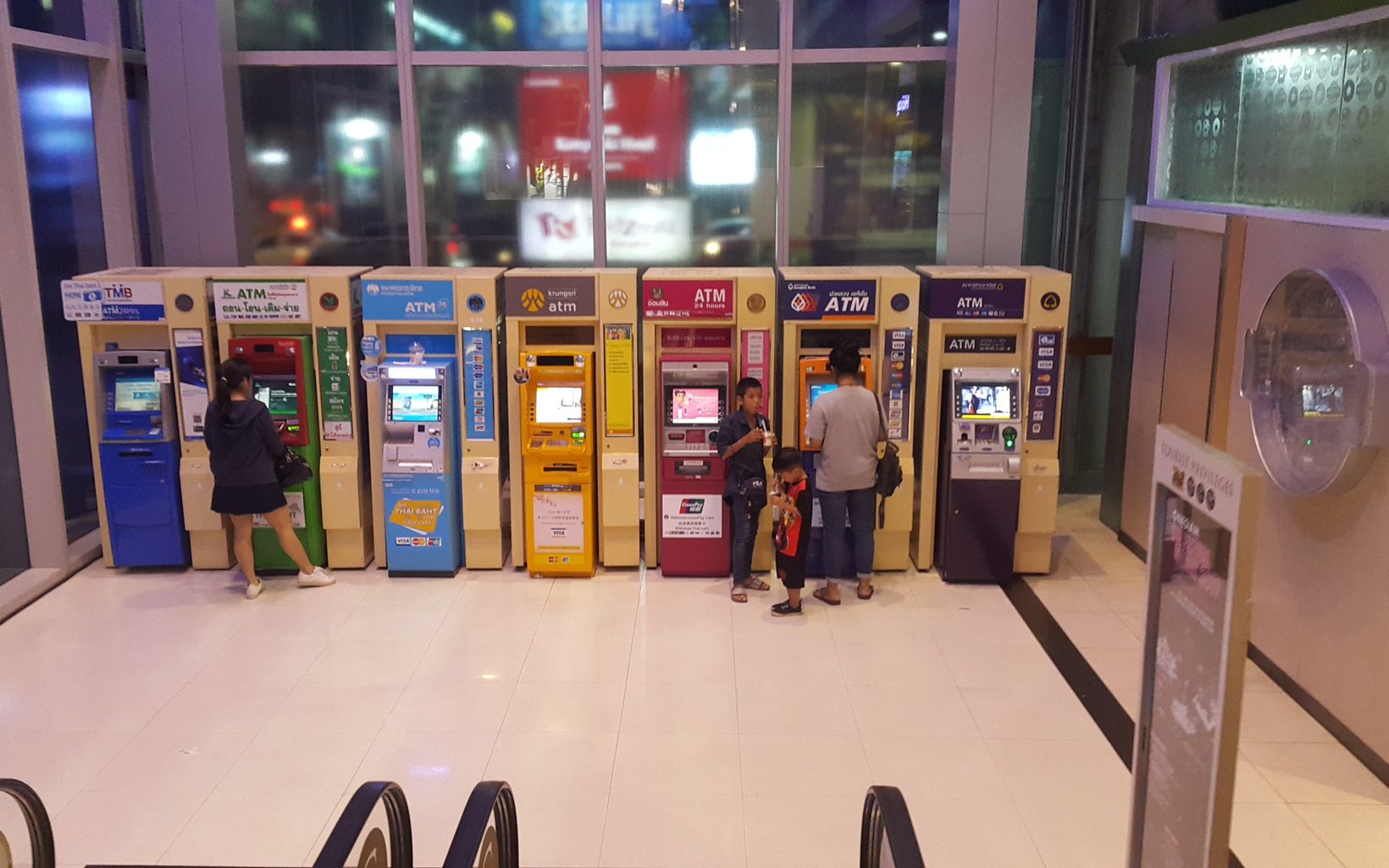
The five Thai banks whose schedules we read charge foreign cards a flat fee on every cash machine withdrawal, and several of those fees rose in 2025 and 2026. This guide sets out what those five banks charge, taken from its own fee schedule, plus the official rules on changing money, paying by card and QR code, and claiming back VAT. Everything was checked on 19 September 2026.
Cash machines: the fee per withdrawal
The five banks below each charge a fixed fee for every cash withdrawal at their machines on a card issued abroad. Kasikornbank’s schedule heads its rows “International credit cards”. Their published schedules:
| Bank | Visa | Mastercard | UnionPay | JCB | Schedule in force from |
|---|---|---|---|---|---|
| Kasikornbank (KBank) | 250 baht | 350 baht | 250 baht | 25 August 2026 | |
| Siam Commercial Bank (SCB) | 250 baht | 350 baht | 250 baht | 250 baht | 1 September 2026 |
| Krungsri (Bank of Ayudhya) | 250 baht | 350 baht | 250 baht | 250 baht | 1 September 2026 |
| TMBThanachart (ttb) | 250 baht | 350 baht | 250 baht | 10 September 2026 | |
| UOB Thailand | 250 baht | 350 baht | 250 baht | 1 July 2026 |
A blank cell means no fee for that card was found in the bank’s schedule. SCB, Krungsri and UOB each charge 50 baht for an American Express card issued abroad. TMBThanachart lists its UnionPay fee under cards outside the Thai ATM network rather than under foreign cards, and UOB’s table of 1 July 2026 marks some other rows as effective until 31 August 2026; no later UOB schedule was found.
The fees have risen. Krungsri charged Mastercard holders 250 baht until 11 March 2026, when it rose to 350. TMBThanachart’s schedule of April 2024 charged 220 baht for foreign Visa and Mastercard cards and 150 for UnionPay; it now charges 250 for Visa and UnionPay and, since 3 March 2026, 350 for Mastercard. UOB raised its UnionPay fee from 220 to 250 baht in November 2025.
What this means. The fee is per withdrawal, not per amount, so one larger withdrawal costs less in Thai fees than several small ones. Krungsri’s cash machine page gives a maximum of 30,000 baht a transaction, and says the daily limit depends on your card’s terms. No limits were found for the other banks.
Not in the table. Bangkok Bank’s and Krungthai’s fee schedules could not be read, and no foreign-card fee was found in the Government Savings Bank’s published fee documents, so none of the three is in the table.
Taking cash out over the counter
Some banks will advance cash on a foreign card at a branch, for a fee:
- Krungsri: 200 baht a transaction with an international Visa card, at its branches and booths.
- UOB Thailand: 200 baht with a Visa or Mastercard issued abroad.
- SCB: 180 baht for a foreign Visa or Mastercard credit card, through the card terminal at the branch. SCB says foreign debit and ATM cards cannot be used to withdraw cash at its branches.
Changing money
Under Thailand’s exchange control law, foreign currency may only be bought, sold or exchanged with someone the Minister of Finance has licensed to do it. For a visitor changing cash, that means a bank or an authorised money changer, which the Bank of Thailand describes as a non-bank company licensed to buy and sell foreign banknotes. Money changers may not offer foreign exchange trading for investment or speculation.
Checking a changer. The Bank of Thailand publishes a list of licensed money changers, with each licence number and head office address. The list current to 31 July 2026 runs to 2,105 entries. The Bank of Thailand’s money-changer page also points to its BOT License Check service, for checking the licence of businesses it supervises.
Carrying cash in or out. The Bank of Thailand says baht, foreign banknotes and negotiable instruments carried in or out must be declared to Customs when together they exceed 450,000 baht or USD 15,000. Our guide to entering Thailand covers the other border rules.
Paying by card: baht or your home currency
Some merchants offer to charge a foreign card in its home currency instead of baht. Visa’s Thailand consumer page explains that this conversion, dynamic currency conversion, is offered by the merchant, with a fee built into the exchange rate, and that to get Visa’s exchange rate you can pay in the local currency instead. It adds that if you were charged in your home currency without choosing to be, you should contact your bank to dispute the charge.
Paying by QR code
The Bank of Thailand’s cross-border payments page describes links between Thailand’s QR payment system and these countries’ payment apps:
| Visitors from | How | Since |
|---|---|---|
| China | Alipay, UnionPay and WeChat Pay, at merchants whose Thai QR code comes from Bangkok Bank, Krungthai, Kasikornbank, ICBC (Thai), SCB or BAAC | 30 October 2025 |
| Laos | Participating banks’ apps, scanning PromptPay QR | 3 April 2024 |
| Cambodia | Mobile banking apps | Not stated |
| Vietnam | Participating banks’ apps | Not stated |
| Malaysia | DuitNow link | Launch, then a second phase |
| Singapore | Link with Singapore’s QR payments (“NET” on the Bank of Thailand’s page) | Not stated |
| Hong Kong | FPS link | Press release of 4 December 2023 |
| South Korea | The Paybooc app | Not stated |
| Indonesia | QRIS link | Not stated |
The Bank of Thailand describes the Japan link (MyPromptQR) only for Thai visitors paying in Japan.
VAT refund for tourists
Visitors can claim back VAT on goods they take home, under the Revenue Department’s rules:
- Buy from a shop showing the “VAT REFUND FOR TOURISTS” sign, and spend at least 2,000 baht, VAT included, per shop per day.
- Ask for form P.P.10 on the day, showing your passport, with the original tax invoices.
- Take the goods out of Thailand within 60 days of buying them.
- Show the goods to Customs before check-in if your purchases total 20,000 baht or more. That threshold rose from 5,000 baht on 1 December 2023.
- Luxury items worth 40,000 baht or more each must be shown again at the VAT Refund for Tourists office after passport control.
- Claim at the VAT Refund for Tourists counter at the airport on the day you leave, or post the documents to the Revenue Department.
Where. The Revenue Department has refund offices at ten international airports: Suvarnabhumi, Don Mueang, Chiang Mai, Phuket, Hat Yai, U-Tapao, Krabi, Samui, Surat Thani and Chiang Rai.
How it is paid. Refunds up to 30,000 baht are paid in cash, in baht, or to an Alipay or WeChat Pay wallet. Refunds over 30,000 baht go only to a credit card: Visa, Mastercard, Diners or JCB.
What you get back. Since 1 September 2013 the refund has come from a fixed table with the processing fee already taken off. A purchase of 2,000 to 2,499.99 baht returns 80 baht, and purchases of 200,000 baht or more return 6.1 per cent of the price.
One figure that differs. The Tourism Authority said in December 2022 that total purchases must reach 5,000 baht per person per trip. The Revenue Department’s own current pages do not say this, and its list of reasons for refusing a claim includes a total under 2,000 baht. The Revenue Department’s current pages give 2,000 baht, not 5,000.
Announced, not confirmed. In May 2025 the Tourism Authority’s newsroom reported that a Cabinet-approved tourism framework said a multi-currency VAT refund system “will be implemented”. The Revenue Department pages cited here do not mention it.
The notes in your wallet
The current series is Series 17, issued on 28 July 2018 in 20, 50, 100, 500 and 1,000 baht. A polymer 20 baht note followed on 24 March 2022, and polymer 50 and 100 baht notes on 21 November 2025, so you may be handed both paper and plastic versions.
Damaged notes. The Bank of Thailand says a damaged note can be exchanged immediately for its full value if at least three-fifths of it remains and it is clearly genuine. Branches of the Government Savings Bank exchange them, as do commercial bank branches on Wednesdays, except those in shopping centres.
What we checked, 19 September 2026
The cash machine fees come from each bank's own published fee schedule, with the date each took effect: Kasikornbank, Siam Commercial Bank, Krungsri, TMBThanachart and UOB. Krungsri's schedule of 1 September 2026 was read directly, and the others were re-opened by a second reader who confirmed each figure. The rules on changing money and declaring cash, the list of licensed money changers, the QR payment links and the banknotes come from the Bank of Thailand; the VAT refund rules from the Revenue Department, with the December 2023 threshold changes from the Government Public Relations Department and two statements from the Tourism Authority of Thailand; card conversion from Visa. Bangkok Bank's and Krungthai's fee schedules could not be read, the first because its site could not be reached and the second because it blocks automated reading, and no foreign-card fee was found in the Government Savings Bank's published fee documents, so those three are not in the table. No Bank of Thailand statement on card surcharges or on whether a passport is needed to change money was found, so neither is stated. This guide describes fees and rules; it is not financial advice.
Sources
- Service fees, announcement 019/2569, effective 25 August 2026, Kasikornbank
- Card and electronic service fees, effective 1 September 2026, Siam Commercial Bank
- Electronic banking service fees, effective 1 September 2026, Krungsri (Bank of Ayudhya)
- Foreign card withdrawal fees, effective 11 March 2026, Krungsri (Bank of Ayudhya)
- Foreign card withdrawal fees, effective 1 July 2025, Krungsri (Bank of Ayudhya)
- Krungsri ATM, Krungsri (Bank of Ayudhya)
- Fee table 3, effective 10 September 2026, TMBThanachart Bank
- Fee table, effective 24 April 2024, TMBThanachart Bank
- Fee table 3.1, No. 013/2026, effective 1 July 2026, UOB Thailand
- Foreign exchange regulations, Bank of Thailand
- Foreign exchange business, Bank of Thailand
- Money changers, Bank of Thailand
- List of authorised money changers, as of 31 July 2026, Bank of Thailand
- Foreign exchange laws: carrying currency in and out, Bank of Thailand
- Travel support: paying in local currency, Visa Thailand
- Thai QR payments linked with China, 30 October 2025, Bank of Thailand
- Cross-border payments, Bank of Thailand
- VAT refund for tourists: how to claim, Revenue Department
- VAT refund for tourists: frequently asked questions, Revenue Department
- New VAT refund processing fees, effective 1 September 2013, Revenue Department
- Reasons a VAT refund is refused, Revenue Department
- VAT refund inspection thresholds raised from 1 December 2023, published 12 January 2024, Government Public Relations Department
- Thailand offers VAT refund for tourists, 16 December 2022, Tourism Authority of Thailand
- Cooperation framework for the 2025 tourism year, 8 May 2025, Tourism Authority of Thailand
- Banknote series 17, Bank of Thailand
- Exchanging damaged banknotes, Bank of Thailand