

FOOD & DINING · 7 min read
Street Food in Thailand: What the Authorities Say
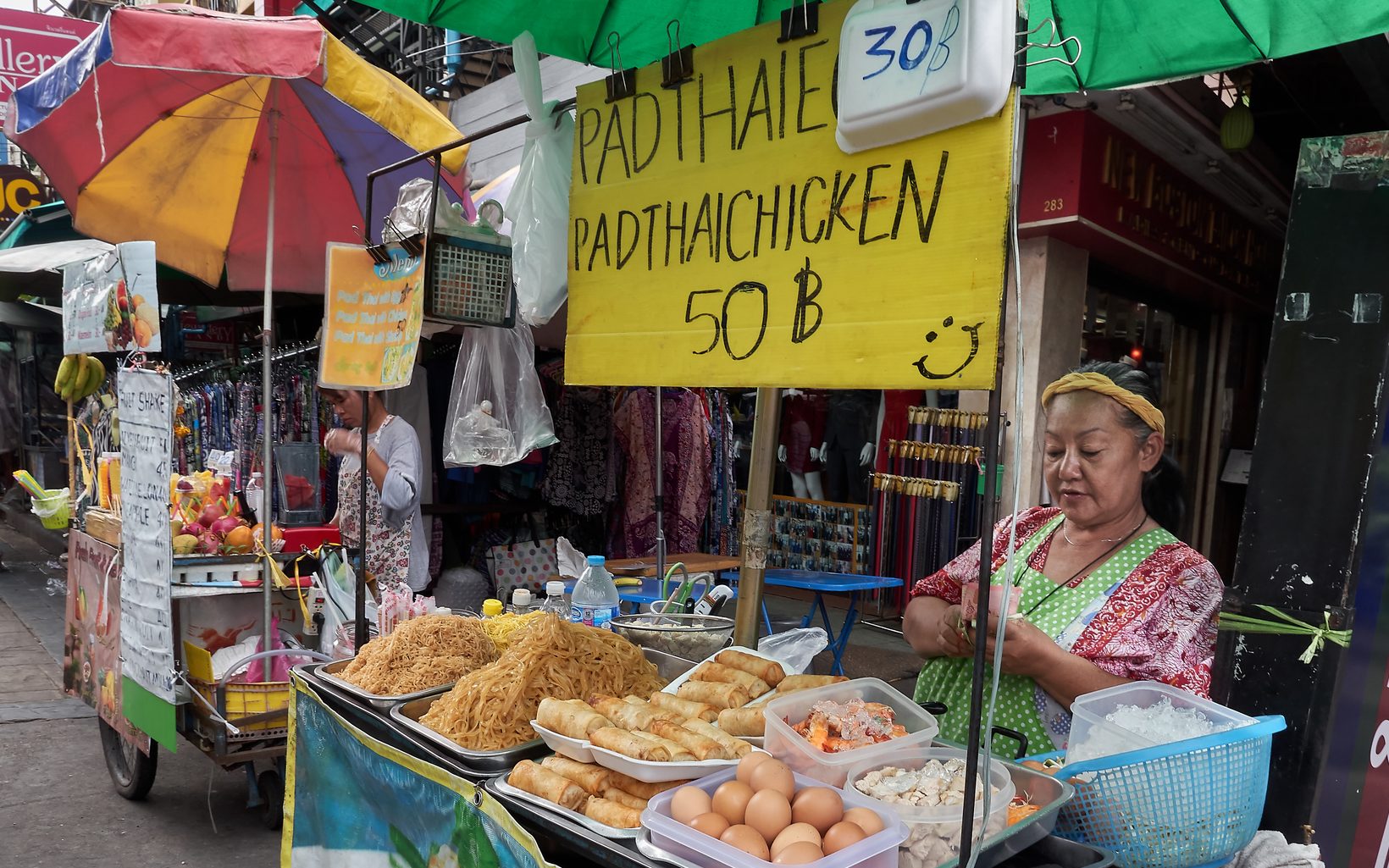
This guide is not a list of favourite stalls. It sets out what the Thai authorities publish about how street food is run and checked, and what health agencies advise travellers, so you can choose well wherever you are.
The hygiene sign has changed
If you have read that a “Clean Food Good Taste” sign marks a checked stall, that is out of date. Thailand’s Department of Health stopped certifying Clean Food Good Taste on 30 September 2023. It has replaced it with two standards, SAN and SAN Plus, which it describes as marks guaranteeing that food is clean, safe and hygienic.
SAN covers restaurants, fresh markets and street stalls, and the department’s sanitation bureau issues its certificate signs in five categories, one of them for street food. A certified operator prints its SAN sign from the department’s system. The department urges the public to buy from places that meet the standard.
We could not find a public register of certified stalls, or a description of exactly what the sign looks like, so treat a SAN sign as a good sign rather than the only one. An old Clean Food Good Taste sign on the wall no longer means a current certificate.
How Bangkok runs its stalls
Bangkok regulates street vending through designated trading points. Under criteria the city adopted in 2024, districts proposed 98 vending points and 63 passed the city’s review, according to the city’s public-relations office in February 2026. Isra News reported the 2024 rules as limiting a stall to 3 square metres and 1.5 metres deep, keeping a clear walkway on the pavement, and requiring vendors to be Thai nationals.
Hours and days are set point by point, so what you find on a street depends on the day and the hour:
- Yaowarat Road, the main street of Chinatown, has two sittings: 96 vendors from 10:00 to 18:00, and 173 from 18:00 to midnight, according to the city.
- Some points close one day a week. The city’s own notices show vendors at one Bang Bon site stopping every Monday and Rat Burana washing its points on Mondays, while the Silom points near Sala Daeng trade Monday to Friday only. News reports describe Monday as a common day off, but it is not the same everywhere.
A new food centre at Lumphini Park. The city has opened a hawker centre at Gate 5 of Lumphini Park on Ratchadamri Road, with more than 100 shops at its soft opening in May 2026. Its posts give an evening sitting of 16:00 to midnight, and two different morning hours, 05:00 to 14:00 and 05:00 to 16:00, so check before going for lunch.
Choosing a stall, by the authorities’ advice
The Tourism Authority of Thailand’s advice for eating safely is practical:
- Pick stalls that are busy with customers, because locals know which are safest.
- Avoid anything that does not look freshly prepared. Street vendors usually cook your order in front of you.
- Stay away from uncooked dishes, such as raw seafood.
- Prices should be clearly displayed.
Foreign health agencies are more cautious. The US CDC’s general advice is to avoid street food, and if you do eat it, to follow the same rules as anywhere: eat food that is cooked and steaming hot, and avoid raw vegetables. It also advises against ice where clean water is limited. For Thailand specifically, the CDC recommends the hepatitis A vaccine for unvaccinated travellers aged one and over, and the typhoid vaccine for most travellers. The UK’s TravelHealthPro advises all travellers to take care with food and water hygiene.
Where Michelin comes in
The Michelin Guide includes Thai street food. The Tourism Authority of Thailand reports that the 2026 guide lists 468 restaurants across the country, including 137 Bib Gourmand and 288 Michelin Selected, and calls Jay Fai a street food legend whose crab omelette earned her restaurant a star. We could not read Michelin’s own pages, so we are not naming individual listings or their prices here.
Thip Samai, from its own website
Thip Samai is a pad thai shop in Bangkok’s Phra Nakhon district with its own website, so it is one we could check. It says the business began as a stall on a footpath with a small charcoal stove, and that the Thipsamai name dates from 9 September 1966.
Its main branch is at 313-315 Maha Chai Road, Phra Nakhon, open from 09:00 to midnight and closed on Tuesdays. It also has branches in ICONSIAM on the sixth floor and in the Siam Paragon food hall, both open 10:00 to 22:00. Its menu lists basic, vegetarian and “superb” pad thai among others, but publishes no prices, so we do not give one.
What we checked, 19 September 2026
The hygiene standards come from Thailand's Department of Health, the Bangkok rules from the Bangkok Metropolitan Administration's own public-relations posts, and the safety advice from the Tourism Authority of Thailand, the US CDC and the UK's TravelHealthPro. The Michelin Guide's own pages refused every request, so no individual Michelin listing is named; the only Michelin figures here are the Tourism Authority's. The text of Bangkok's 2024 vending announcement would not load, so its stall rules are given as reported by Isra News. Thip Samai's menu pages list no prices, so we give none.
Sources
- SAN and SAN Plus replace Clean Food Good Taste, Department of Health, Ministry of Public Health
- Launch of SAN and SAN Plus, Bureau of Food and Water Sanitation, Department of Health
- Street vending points under the 2024 criteria, Bangkok Metropolitan Administration Public Relations
- Yaowarat and Ratchawong vending hours, Bangkok Metropolitan Administration Public Relations
- Bang Bon vendors stop trading every Monday, Bangkok Metropolitan Administration Public Relations
- Silom vendors trade Monday to Friday, Bangkok Metropolitan Administration Public Relations
- Lumphini Park food centre opens, Bangkok Metropolitan Administration Public Relations
- Lumphini Park hawker centre plans, Bangkok Metropolitan Administration Public Relations
- Bangkok's 2024 vending announcement, Isra News Agency
- Useful things to know for safe and enjoyable eating in Thailand, Tourism Authority of Thailand
- The MICHELIN Guide Thailand 2026, Tourism Authority of Thailand
- Food and water safety for travellers, US Centers for Disease Control and Prevention
- Thailand: health information for travellers, US Centers for Disease Control and Prevention
- Thailand, TravelHealthPro (NaTHNaC)
- Our story, Thipsamai
- Contact and branches, Thipsamai