

GETTING AROUND · 8 min read
Grab, Bolt and Taxis in Thailand: What the Rules Say
Ride-hailing apps are legal in Thailand, and in 2026 the government tightened the rules on who may drive for them. This guide sets out those rules, what Grab and Bolt each say they offer, and how metered taxis and the airports work, all from the government and the companies themselves.
What it does not do is tell you which app is cheaper. We have not measured fares or waiting times on either, and nobody should publish a comparison they have not measured.
The rules, and what changed in 2026
Ride-hailing cars have been a legal category since a ministerial regulation in 2021, under which the Department of Land Transport certifies the apps. In 2025 a further announcement in the Royal Gazette set out what the platforms themselves must do, and the Government Public Relations Department confirmed it took effect on 31 March 2026.
Under it, platforms must make sure their drivers use cars registered as public vehicles and hold a public driving licence, and must charge fares under the law that sets passenger fares. In June 2026 the Transport Ministry added five measures, reported by the Public Relations Department:
- Every driver on a ride-hailing app must hold a public driving licence. Drivers already on the apps have until 30 September 2026, after which their accounts must be suspended.
- Every trip booked through an app must carry insurance covering both passenger and driver.
- A metered taxi booked through an app may carry a 20 baht booking fee and nothing more.
- The commission an app takes from a ride-hailing car’s fare is capped at 25 percent.
News reports say the Department of Land Transport has ruled out extending the September deadline. We could not confirm that from the department itself, whose websites would not load.
What the app must show you
The 2025 announcement is specific about what a passenger sees. While you wait, the app must show the driver’s name and photo and the car’s plate number, the province it is registered in, and its type, model and colour. Before the trip you should see the pick-up and drop-off points, the distance, route, journey time and fare. The platform must be able to take a call for help or an emergency report at any hour.
When you choose a vehicle, the app must list ordinary taxis first, then electric ride-hailing cars, then the other ride-hailing cars from the cheapest fare to the dearest.
Grab, in its own words
Grab’s Thailand pages describe three main ways to book a car:
- JustGrab assigns whichever is nearest from Grab’s cars and taxis, at an upfront fare. If a taxi turns up, you pay the upfront fare, not the meter.
- GrabTaxi is a metered taxi, with the meter started only once you are in. The booking fee is 20 baht, 45 baht for an advance booking and 150 baht for a seven-seat taxi.
- GrabCar is a private-hire car at an upfront fixed fare, which Grab says is subject to surge pricing. Grab’s car prices exclude tolls and surcharges.
GrabBike, its motorbike service, runs only in Bangkok, Nonthaburi, Pathum Thani and Samut Prakan. Grab’s list of locations includes Bangkok, Pattaya, Hua Hin, Chiang Mai, Chiang Rai, Phuket, Samui, Krabi and Hat Yai, though it does not say which ride types run in each. It takes cash, cards and GrabPay.
On safety, Grab lists an in-trip emergency button, live location sharing, selfie checks on drivers before they can take bookings, masked phone numbers and a 24-hour safety centre.
Bolt, in its own words
Bolt’s cities page lists 13 places in Thailand: Bangkok, Buriram, Chiang Mai, Chiang Rai, Khon Kaen, Krabi, Maha Sarakham, Nakhon Ratchasima, Nakhon Si Thammarat, Phitsanulok, Phuket, Surat Thani and Udon Thani. Pattaya, Hua Hin and Koh Samui are not on it.
In Bangkok it lists seven ride types, including local taxis, a one-passenger motorbike called Motor, and Ladies, a women-only option that needs verification. Bolt says prices depend on distance and ride type, with an estimate shown once you enter a destination. It takes cards in the app, and says cash or mobile payment may be available depending on where you are.
Its safety features, by its own list, are an emergency assist button, sharing the car’s details and your live location, pick-up codes so nobody else takes your ride, a check that flags unexpectedly long stops, masked phone numbers and 24-hour support.
Bolt’s certification. News reports in 2026 (Thairath English, Thai PBS World, Spacebar and MGR Online among them) describe the Department of Land Transport warning that it might not renew Bolt’s certificate when it expired in May, then granting a conditional extension. Bolt’s Thailand general manager attended a government briefing on enforcement on 1 May 2026, according to the Electronic Transactions Development Agency. We could not confirm Bolt’s current status from the department.
Metered taxis
Airports of Thailand publishes the Bangkok taxi fare on its Suvarnabhumi pages: 35 baht for the first kilometre, then 6.50 baht a kilometre to 10km, 7.00 to 20km, 8.00 to 40km, 8.50 to 60km, 9.00 to 80km and 10.50 beyond that. The page is undated and cites no source, so treat it as a guide. News reports from 2023 add a slow-traffic charge of 3 baht a minute and a 40 baht start for larger taxis.
At the airports
Suvarnabhumi. The public taxi counter and ticket machines are on Floor 1, between Gates 4 and 7. Airports of Thailand says a 50 baht airport charge is added to the meter and paid to the driver, and that expressway tolls are paid by the passenger. Grab picks up at Level 1, Gate 4 on the outer kerb, according to Airports of Thailand, and Grab’s own page gives Arrival Exit 4 on the first floor. Bolt publishes no fixed point and says it is shown in the app.
Don Mueang. Metered taxis wait at Gate 8 on the first floor of the international terminal and next to Gate 15 at the domestic terminal, with the same 50 baht charge added. Grab gives its pick-up points as International Arrival Exits 2 and 5, and Airports of Thailand lists a Grab counter at Gate 14 in the domestic terminal, so check the app on the day.
Motorbike taxis
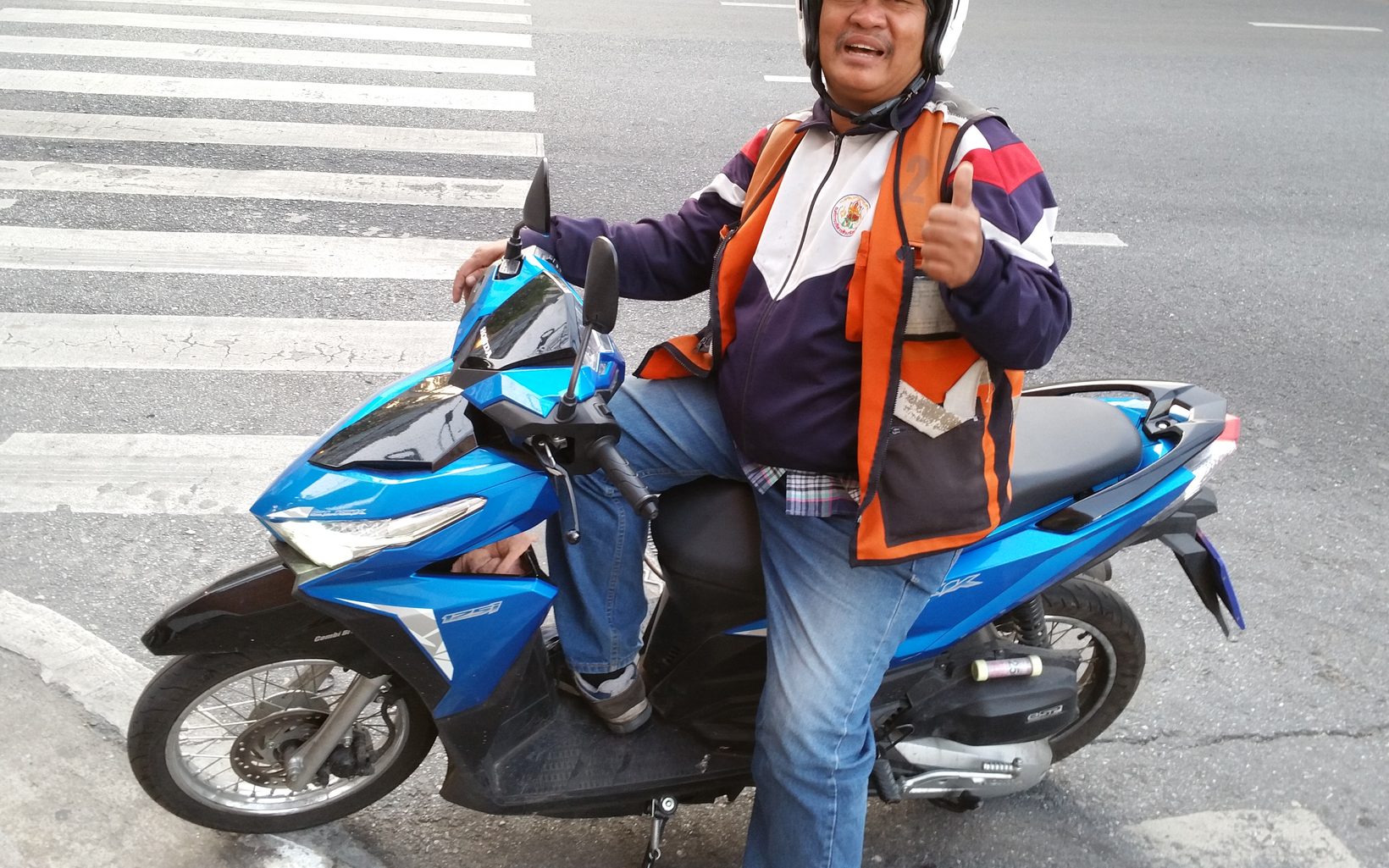
The Department of Land Transport, through the Public Relations Department, says a legal motorbike taxi is registered as a public vehicle with a yellow plate, and its rider holds a public driving licence. Check that the rider, the vest, the ID card and the registration all match. Complaints go to the department’s 24-hour hotline, 1584.
What we checked, 19 September 2026
The rules come from the Royal Gazette, the Government Public Relations Department and the Electronic Transactions Development Agency; the services come from Grab's and Bolt's own pages; the airport details from Airports of Thailand. The Department of Land Transport's own websites would not load, so the 2021 ministerial regulation is confirmed only through the department's later gazetted announcement, and its current list of certified apps could not be read: the most recent government list we found is from October 2024. Bolt's certification in 2026 is described only in news reports, and they are named as such. We have not measured fares or waiting times on either app, so this guide does not say which is cheaper or faster.
Sources
- Electronic Transactions Commission announcement on ride-hailing platforms, B.E. 2568, Royal Thai Government Gazette
- Department of Land Transport announcement (No. 2) B.E. 2565 on ride-hailing systems, Royal Thai Government Gazette, via the Office of Insurance Commission
- Ride-sharing rules take effect 31 March 2026, Government Public Relations Department
- Transport Ministry's five measures for ride-hailing apps, 12 June 2026, Government Public Relations Department
- Platforms must suspend non-compliant drivers, Electronic Transactions Development Agency
- What passengers get under the new rules, Electronic Transactions Development Agency
- Motorcycle taxi advice, Government Public Relations Department, relaying the Department of Land Transport
- Transport in Thailand, Grab
- JustGrab, Grab
- GrabTaxi, Grab
- GrabBike, Grab
- Safety, Grab
- Cities, Bolt
- Bangkok, Bolt
- Rides in Thailand, Bolt
- Taxi fares, Airports of Thailand, Suvarnabhumi
- Public taxi service, Airports of Thailand, Suvarnabhumi
- Grab at Suvarnabhumi, Airports of Thailand, Suvarnabhumi
- Public taxi service, Airports of Thailand, Don Mueang