

GETTING AROUND · 8 min
Renting a Scooter in Thailand: the Licence, the Helmet Law, Drink-Driving, and What Your Insurance May Not Cover
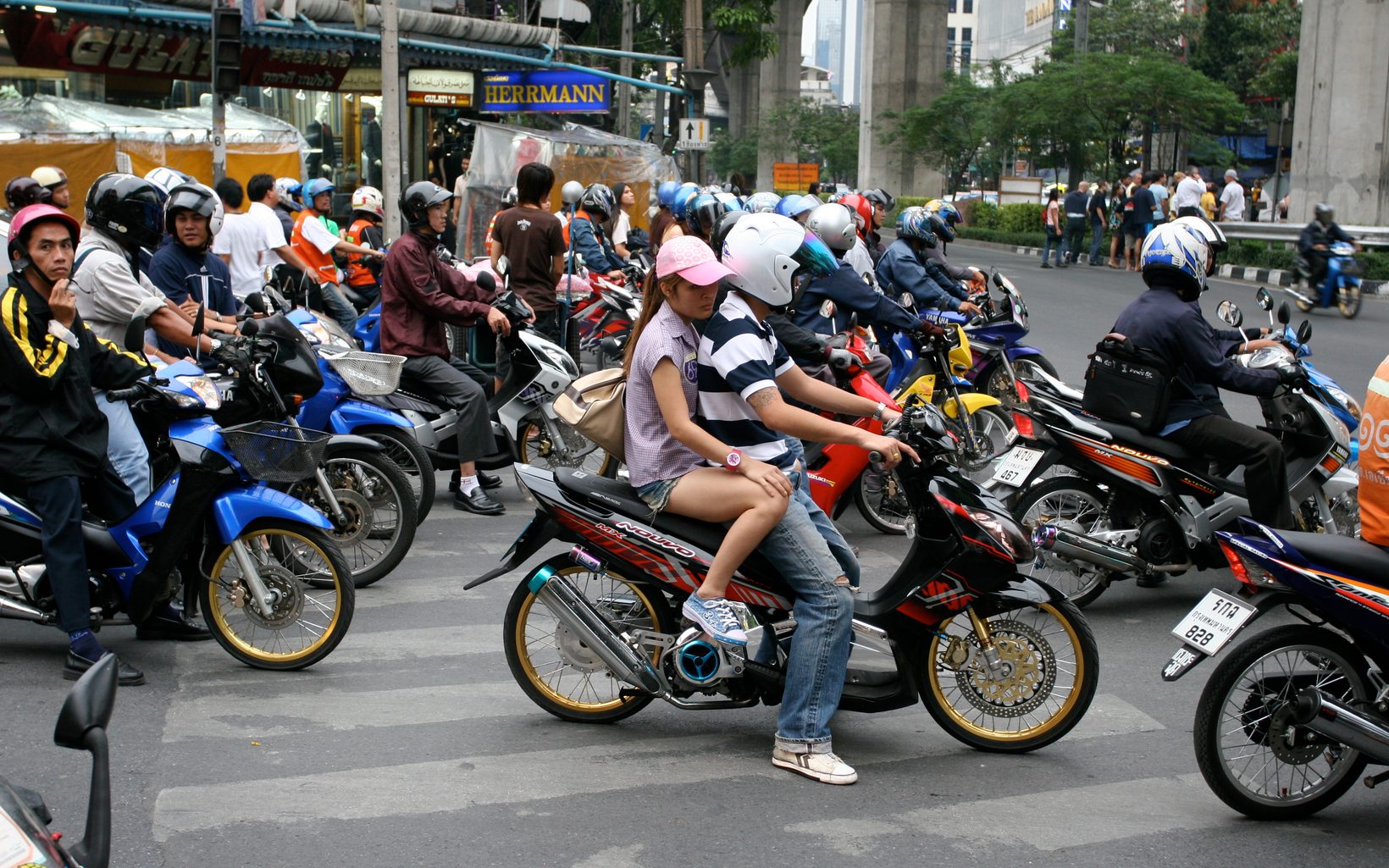
Scooters are for hire across Thailand’s tourist areas, and they are where the country’s road deaths are concentrated. The World Health Organization’s Thailand office says motorcyclists accounted for 83.8% of all traffic deaths in 2021, in a year when it estimates 18,218 people died on the roads, about 50 a day. What follows is what the law asks of a visitor who rents one, and what four governments tell their own citizens about licences and insurance.
The short version
- Hold a licence that covers motorcycles, and carry it with an International Driving Permit. Thai law limits you to the categories on your licence, and Australia, the UK and Canada each say so in their own words.
- Wear a helmet, and make your passenger wear one. The fine is up to 2,000 baht, and double for a rider carrying a passenger without one.
- The drink-driving limit is 50 milligrams per cent, or 20 if your licence does not cover what you are riding.
- Do not leave your passport as a deposit.
- Read your travel insurance before you rent. Three of the four governments warn that a policy may not pay out if you ride without the right licence.
The licence
What Thailand says. Guidelines from the Ministry of Transport, published by the Public Relations Department in November 2024, name three kinds of licence a foreigner may drive on: a Thai licence, a valid International Driving Permit, or a licence issued in another ASEAN country. The Motor Vehicle Act is more specific. Section 42 lets a foreigner staying in Thailand temporarily drive on a licence recognised under Section 42 bis, carried with the documents the relevant convention or agreement requires, and Section 42 bis allows that licence to be used only “according to the category and type of vehicle specified” in it. The Act defines a motorcycle as any engine or electric vehicle with no more than two wheels, which takes in every rental scooter. On the Act’s own words, then, the categories on your licence are the limit: a licence that does not cover motorcycles does not cover a scooter. The Department of Land Transport says Thailand is a party to both conventions under which permits are issued, the 1949 Geneva convention and the 1968 Vienna one. None of these sources says how long a visitor may drive on a permit.
What the governments add. Each of them is writing for its own citizens:
- Australia: you need an International Driving Permit and your Australian licence “for the type of vehicle you’re using”, and Australian digital licences may not be accepted. On motorbikes it is blunt: you need a valid motorcycle licence, and “some rental companies will tell you otherwise.” Without the correct licence, it says, you could be arrested or jailed.
- The United Kingdom: carry both the 1968 version of the permit and your UK licence, and get the permit before you travel, because it cannot be bought outside the UK.
- Canada: operating a motorcycle is illegal without a valid Thai motorcycle licence or an International Driving Permit with a motorcycle endorsement. It also tells travellers to carry identification, their licence and the vehicle’s registration book at all times.
- New Zealand: SafeTravel’s page does not address licences.
The penalty. Driving without a licence carries up to 1 month in prison or a fine of up to 1,000 baht, or both, under the Motor Vehicle Act. The larger cost is the one in the insurance section below.
Helmets
Under Section 122 of the Land Traffic Act, as the police traffic centre stated it, motorbike riders and their passengers must both wear helmets. The fine is up to 2,000 baht, and a rider who carries a passenger without a helmet is fined double. The police announced an enforcement drive from 1 June 2025.
Many riders ignore it. The World Health Organization’s 2023 country profile records helmet wearing at 52% for riders and 21% for passengers.
The helmet you are handed may not be much use either. Canada warns that many helmets do not meet international safety standards; Australia says hire companies and motorcycle taxis rarely provide helmets, and you may need to shop around to hire one; New Zealand asks travellers to consider carefully the safety standards of any vehicle and equipment, such as helmets, that they hire.
Drink-driving
A Ministerial Regulation published in the Royal Gazette on 20 September 2024 sets the limits. A rider is treated as drunk above 50 milligrams of alcohol per 100 millilitres of blood, or above 20 for four groups:
- riders under 20;
- holders of a temporary licence;
- riders holding a licence for a different kind of vehicle, one that cannot be used in its place;
- riders with no licence, or whose licence is suspended or revoked.
Read plainly, a visitor riding a scooter on a licence that covers only cars falls into one of the last two groups, and so faces the lower limit. The test is a breath test in the first instance; urine or blood may be tested instead, but only with the rider’s consent.
Australia’s advice adds two facts worth knowing before a night out: Australians are regularly injured or killed in motorbike accidents in Thailand, often with alcohol involved, and a travel insurance policy may be void if your blood alcohol level is over a certain limit.
Renting one
- Keep your passport. The UK, Australia and Canada all tell their citizens not to hand a passport to a rental business as a guarantee, because companies may hold on to it and demand payment for damage. Our scams guide covers how those damage claims play out.
- Check it is registered. The UK warns that motorcycles and scooters for hire in tourist areas are often unregistered and cannot be used legally on a public road. Canada’s advice to carry the vehicle’s registration book gives you a reason to ask for it.
- Check the bike. Canada says rental scooters and motorcycles are often poorly maintained, and advises photographing any existing damage as proof that it was already there.
- Check the bike’s own insurance. Australia says many vehicle hire companies do not have insurance, and that you should make sure the company has comprehensive and third-party cover. Canada advises reading the contract to make sure the vehicle is insured against damage and theft.
- Read the lease for limits. The UK advises checking the small print, paying particular attention to any limits on engine size and the licences required.
What your travel insurance may not cover
This is the part that turns a crash into a bill. Three governments say it directly:
- The UK: many policies expect you to hold the correct UK licence for the type of vehicle you ride abroad, so if you could not legally ride it in the UK, your insurer may not cover you in Thailand. Riding without a valid licence could invalidate your insurance, leaving you unable to claim after an accident or injury.
- Australia: do not ride anything your Australian licence does not cover, because you may not be insured if you crash; you may need to pay extra for motorcycling as an activity; and a policy may be void above a blood alcohol limit. If you do crash, you could be responsible for damage, loss and the cost of injuring others, and the embassy cannot help you negotiate compensation.
- Canada: insurance claims could be denied if you were riding without a motorcycle licence.
New Zealand’s advice is general: have comprehensive travel insurance that includes medical evacuation by air.
Australia is also clear about why it matters: there is no agreement giving Australians free healthcare in Thailand, and hospitals need a deposit, and to confirm your insurance and your visa, before admitting you; otherwise you may have to pay cash up front. The practical step is the same for everyone: read your own policy’s wording on motorcycles, engine sizes and licences before you rent, not after.
The risk, in numbers
The World Health Organization’s Thailand office puts the road death rate at 25.4 per 100,000 people in 2021, and ranks Thailand ninth of 175 member countries for road traffic deaths. The 83.8% share quoted at the top is the figure its Thailand office gives. Thailand’s own reported figures, tabulated in the organisation’s 2023 country profile, put motorcycle riders at 51% of the deaths reported in 2021, but leave 46% unclassified. Canada says motorcycle accidents are responsible for the majority of road deaths, and advises its citizens to avoid riding motorcycles in Thailand altogether, even if they are experienced riders. The UK notes that the World Health Organization ranks Thailand among the world’s deadliest countries for motorcycle fatalities.
Over Songkran in 2026, the government’s seven-day road safety campaign recorded 95 deaths in its first three days; our holidays guide has the dates to plan around. If you would rather not ride at all, our guide to Grab, Bolt and taxis covers the alternatives, including licensed motorbike taxis.
What we could not confirm
- The Land Traffic Act’s own penalties for drink-driving, and its rules on passengers and on keeping left. Every copy of the Act that was tried either refused the connection or would not open as text. Canada’s advice notes that traffic drives on the left.
- How long a visitor may ride on a permit. No Thai government page we read states it.
- Whether a 1949 permit and a 1968 permit are treated the same for motorcycles. Thailand is a party to both conventions, and the UK specifies the 1968 permit for its own citizens.
- Rental prices, which no source we accept publishes.
What we checked, 22 September 2026
The licence, helmet and drink-driving rules come from Thai government sources: the Public Relations Department's reports of the Ministry of Transport's guidance on who may drive, of the Department of Land Transport's explanation of international permits, of the police traffic centre's helmet enforcement, and of the Ministerial Regulation on alcohol testing published in the Royal Gazette on 20 September 2024. The Motor Vehicle Act was read in a consolidated text that may not include the latest amendments. What four governments tell their own citizens was read on their current pages on 22 September 2026, in a browser: Australia, the United Kingdom, Canada and New Zealand. Road death figures come from the World Health Organization. The Land Traffic Act's own text could not be read in any copy we tried, so its penalties for drink-driving are not printed; the helmet rule is quoted as the police traffic centre stated it. No rental price is printed, because no operator or authority we accept publishes one. Nobody on this site has ridden for this guide.
Sources
- Thailand travel advice, updated 3 June 2026, Smartraveller, Australian Government
- Thailand travel advice: safety and security, UK Foreign, Commonwealth and Development Office
- Travel advice and advisories: Thailand, updated 9 September 2026, Government of Canada
- Thailand travel advice, updated 4 September 2026, New Zealand Ministry of Foreign Affairs and Trade (SafeTravel)
- Who may drive in Thailand, 19 November 2024, Government Public Relations Department, relaying the Ministry of Transport
- International driving permits under the 1949 and 1968 conventions, 22 February 2023, Government Public Relations Department, relaying the Department of Land Transport
- Motor Vehicle Act B.E. 2522, consolidated text, Office of the Council of State, hosted by the Royal Police Cadet Academy
- Helmet fines and the enforcement drive from 1 June 2025, Government Public Relations Department, relaying the Royal Thai Police Traffic Management Centre
- Ministerial Regulation on testing drivers for alcohol, 23 September 2024, Government Public Relations Department
- Road safety in Thailand, World Health Organization, Thailand country office
- Global status report on road safety 2023: Thailand country profile, World Health Organization