

BEFORE YOU GO · 14 min read
The Thai Laws That Catch Tourists Out, With the Penalties From the Law Itself
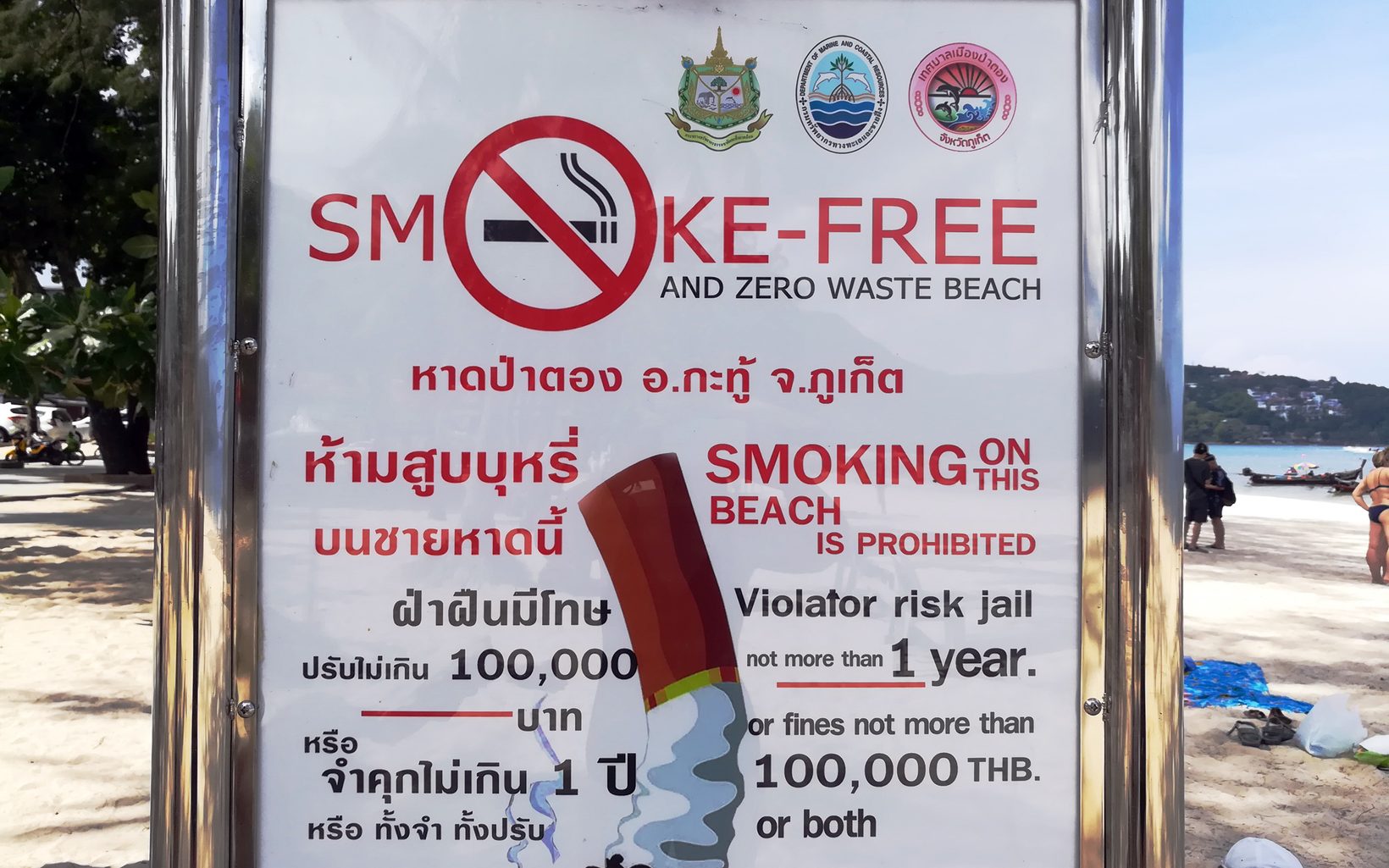
Most of Thailand’s rules are the ones you would expect anywhere. A handful are not, and several changed in the last eighteen months: alcohol hours, cannabis and drones all moved in 2025 or 2026. What follows is each rule as it stands on 19 September 2026, and the penalty the law sets, taken from the Royal Gazette, the law’s own text or the department that enforces it. Penalties are maximums unless a minimum is given.
The short list
| Rule | Maximum penalty | What changed |
|---|---|---|
| No vapes or e-cigarettes: not brought in, bought, owned or used | 10 years for importing, 5 for possessing | Police raids on sellers, August 2026 |
| Cannabis only on a Thai prescription, 30 days’ supply at most | 1 year or 20,000 baht for selling without a licence | Medical use only since June 2025 |
| Alcohol on sale from 11:00 to midnight only | 10,000 baht fine for drinking in a bar after hours | Afternoon ban lifted 29 May 2026 |
| No smoking on 24 listed beaches | 1 year or 100,000 baht | |
| Drones registered with the NBTC and the aviation authority before flying | 1 year or 40,000 baht | Border-province ban eased, June 2026 |
| Buddha images and antiques need an export permit | 10 years for a registered antique | |
| Helmets for rider and passenger | 2,000 baht, double for a rider carrying a bare-headed passenger | Enforcement drive from 1 June 2025 |
| The monarchy, Section 112 | 3 to 15 years |
Vapes and e-cigarettes
The Tourism Authority says e-cigarettes have been banned in Thailand since 2014, and advises travellers not to bring them, or anything that goes with them, such as e-liquid. It reported that foreign visitors who did not know about the ban had been given on-the-spot fines or arrested. That statement dates from 2017.
The UK government’s current advice says it is illegal to possess or use any vape, e-cigarette, pod, e-liquid or heat-not-burn device in Thailand, and that fines are typically 5,000 to 30,000 baht.
The penalties the law allows are far higher. In a joint statement in 2023, five Thai agencies, including the police and Customs, set them out:
- Importing: e-cigarettes are prohibited goods under a 2014 Ministry of Commerce announcement, which carries up to 10 years in prison, a fine of five times the value of the goods, or both. Under Section 244 of the Customs Act it is up to 10 years or a fine of up to 500,000 baht, or both.
- Selling or supplying: up to 3 years in prison or a fine of up to 600,000 baht, or both, under the Consumer Protection Act.
- Possessing or receiving: up to 5 years in prison or a fine of four times the value of the goods, under Section 246 of the Customs Act. The Customs Department’s own summary of the same section gives up to 5 years or a fine of up to 500,000 baht, for knowingly receiving goods that evade a prohibition. The two official sources disagree on the fine, and we did not read the Act itself.
A 2024 order of the Product and Service Safety Committee, reported when it was published in the Royal Gazette, also bans selling shisha (baraku), electronic shisha and e-cigarettes, and their liquids.
Enforcement in 2026. A Royal Thai Police centre for e-cigarette and tobacco offences was raiding sellers in August 2026, including at Khlong Thom market on 7 August, and takes tip-offs on the police hotline 1599.
Cannabis: medical use only
The rules tightened in 2025. The Tourism Authority says that since June 2025, tourists may not use, buy, carry or transport cannabis flower unless they hold a valid prescription issued in Thailand by a licensed practitioner, and that supply is limited to 30 days. The Ministry of Public Health’s 2025 notification made the flower a controlled herb that can only be dispensed on prescription.
Where and how it can be sold. Restating the rules in August 2026, the government listed:
- no sale without a licence, and no sale without a prescription;
- no online or vending-machine sales;
- no sale at temples, schools, dormitories, public parks, zoos or amusement parks;
- no smoking or use at the point of sale, except for treatment.
Selling without a licence carries up to 1 year in prison or a fine of up to 20,000 baht, or both, under the Thai Traditional Medicine Wisdom Act.
Tighter licensing from April 2026. A Ministry of Public Health regulation published in the Royal Gazette on 30 April 2026 limits new licences to sell cannabis flower to health facilities, pharmacies and a short list of other licence holders. Licensed shops must have a trained worker on site whenever they are open and a system to remove smoke and smell, and the regulation’s stated aim is to restrict the flower to medical use. Existing licences run until they expire, and licences suspended for breaking the rules will not be renewed.
Smoking it in public. The Department of Thai Traditional and Alternative Medicine’s own answers say smoking cannabis in public breaks the Public Health Act, with up to 1 month in prison or a fine of up to 2,000 baht, or both. Separately, a 2022 ministry notification makes cannabis smoke or smell a legal nuisance, and ignoring a local official’s order to stop carries up to 3 months or 25,000 baht, or both, according to the Department of Health. The traditional medicine department’s answers also advise anyone carrying cannabis for treatment to carry a doctor’s certificate or a copy of the prescription.
Taking it home. The UK government’s advice says recreational use remains illegal, and that trying to take cannabis out of Thailand brings fines starting at 30,000 baht per kilogram.
What is still only a proposal. In May 2026 the traditional medicine department published a timetable for a draft Cannabis and Hemp Act, aiming to put it to the Cabinet in July 2026. We found nothing to show it has become law. A news report in June 2026 said a parliamentary health committee was due to consider a call from a medical network to put cannabis back under the narcotics law. Neither changes the rules above.
Alcohol
When it can be sold: 11:00 to midnight
Since 29 May 2026, alcohol may be sold from 11:00 to midnight, in one continuous window, under an Alcohol Control Committee announcement published in the Royal Gazette on 28 May. It replaced a six-month trial, from December 2025, that allowed sales between 14:00 and 17:00, hours when they had been banned. The afternoon ban has not come back.
The announcement lets a few places sell outside those hours: passenger buildings at international airports, licensed entertainment venues within their own licensed hours, hotels, and designated event areas in a special zone in Rayong.
Drinking in a bar after hours
An amendment to the Alcoholic Beverage Control Act, published on 9 September 2025 and in force 60 days later, made it an offence for customers to drink in a place that sells or serves alcohol during hours when sale is banned. It is an administrative offence with a fine of up to 10,000 baht. A committee announcement of December 2025 gives a grace period: if you started drinking before the ban began, you may carry on for up to an hour. That announcement has no end date in its text, and the May 2026 changes did not revoke it.
Days when it cannot be sold
- Five Buddhist holy days: Makha Bucha, Visakha Bucha, Asanha Bucha, Khao Phansa and Ok Phansa. The rule is a Prime Minister’s Office announcement in force since 10 May 2025. It exempts international airport passenger buildings, licensed entertainment venues, businesses in tourist areas designated by the Minister of Public Health, hotels, and designated national or international events. For Asanha Bucha and Khao Phansa in 2026, a news report said the police announced a ban from 00:01 on 29 July to midnight at the end of 30 July, with a penalty of up to 6 months or 10,000 baht, or both.
- Election days: for the general election of 8 February 2026, the Election Commission banned selling or giving away alcohol from 18:00 the day before polling until 18:00 on polling day, with the same penalty.
A draft committee announcement on banned days was open for public comment in May 2026. We found no sign that it has been published.
Places where it cannot be sold or drunk
The Alcoholic Beverage Control Act bans sales at places including temples and places of worship, state health facilities, hospitals and pharmacies, government premises (apart from designated shops, clubs and areas), dormitories, schools, petrol stations and the shops on their forecourts, and government-run public parks. It bans drinking at temples (except as part of a religious rite), health facilities and pharmacies, government premises, schools, petrol stations and government-run parks. Drinking somewhere it is banned carries up to 6 months in prison or a fine of up to 10,000 baht, or both.
Announcements in force since May 2026 add that alcohol may not be sold on a road or in a vehicle on a road, may not be drunk while driving or riding, or as a passenger in or on a vehicle on a road, and may not be sold or drunk in public parks run by state enterprises and agencies. A news report said eight such announcements took effect that month, also covering transport stations, public ports and passenger boats, and railway stations and trains. The Marine Department’s own rules on piers and boats are in our island ferry guide.
The age limit is 20
Selling alcohol to anyone under 20, or to anyone who is drunk, is banned, and where age is in doubt the seller must ask to see an identity card or other official proof of age. The seller faces up to 1 year in prison or a fine of up to 100,000 baht, or both.
Illegal drugs
Thailand’s Narcotics Code of 2021 sorts drugs into five schedules. Heroin is in Schedule I, and morphine, cocaine, codeine and medicinal opium in Schedule II. The penalties below come from the Narcotics Control Board’s unofficial English translation:
| Offence | Maximum penalty |
|---|---|
| Producing, importing, exporting, distributing or possessing a Schedule I drug | 15 years or 1.5 million baht |
| The same, aggravated: for trade, supplying under-18s, or on the premises of a school, temple or government office | 2 to 20 years and 200,000 to 2 million baht |
| The same, by a syndicate leader or affecting state security | 5 years to life and 500,000 to 5 million baht, or death |
| Schedule II or IV, such as cocaine | 10 years or 1 million baht |
| Using a Schedule I, II or V drug | 1 year or 20,000 baht, or both |
| Possessing for personal use | 2 years or 40,000 baht, or both |
Small quantities below thresholds set by ministerial regulation are presumed to be for personal use, and in those cases a court may favour treatment over punishment. The UK government’s advice warns that even small quantities can mean heavy fines or prison.
Bringing prescription medicines
Ordinary medicines and some controlled ones are allowed, within limits:
- Psychotropic medicines (Schedules II to IV of the psychotropic lists): up to 30 days’ supply without a permit, with a prescription or medical certificate, under Section 39 of the Narcotics Code. More than that needs permission.
- Narcotic medicines containing Schedule II or III narcotics: up to 90 days’ supply, but only with a permit from the Food and Drug Administration, applied for at least 15 days before you travel. Psychotropic medicines above 30 days, up to 90, need the same permit.
The FDA takes applications online at permitfortraveler.fda.moph.go.th and says they take about three working days. The Thai embassy in Stockholm gives 14 days rather than 15 and limits ordinary prescription medicines to 30 days’ use; the FDA’s figure is the safer one to plan around. It also says narcotic medicines must be declared at the red channel.
Smoking on the beach
The Department of Marine and Coastal Resources banned smoking on listed beaches from 1 February 2018, under Section 17 of the Marine and Coastal Resources Act of 2015. The penalty is up to 1 year in prison or a fine of up to 100,000 baht, or both, which is exactly what the sign at Patong in the photo above says.
The department’s project page lists 24 beaches. Those at destinations we cover are Patong in Phuket, Bo Phut on Koh Samui, Chalok Ban Kao on Koh Tao, Hua Hin, Khao Takiab and Cha-am, and Khlong Dao and Phra Ae (Long Beach) on Koh Lanta. The others it names are Ban Chuen, Chao Lao and Laem Sadet, Saeng Chan, Sai Kaew, Dong Tan, Tham Phang, Bang Saen, Sai Ri, Plai Sai, Chalatat, Khao Lak, Ko Khai Nok, Ko Khai Nai, Samran, Wasukri and Laem Khok Kwang.
The department says it provides designated smoking areas along the beaches the ban covers. Its list is undated, and a later order from 2020 could not be read, so the list may have changed. Canada’s travel advice, updated on 9 September 2026, says the ban is still in force on several beaches. Some islands add their own rules: Koh Nang Yuan bans smoking on its beach outright.
Flying a drone
The Tourism Authority’s June 2026 guide for tourists says you may bring a drone in, but may not fly it until it is registered with both the NBTC and the Civil Aviation Authority of Thailand. The NBTC registers the owner and the aviation authority the pilot. Any drone with a camera must be registered with the aviation authority, whatever its weight.
The other rules in the Tourism Authority’s guide:
- Registration through the aviation authority’s portal needs a Thai SIM card, which you can buy on arrival.
- Third-party liability insurance of at least 1 million baht.
- No flying within 9 km of an airport without prior approval.
- No flying over built-up areas or crowds, or near government buildings, hospitals or military zones, unless authorised.
- Keep 30 metres from people and property with a drone under 2 kg, and 50 metres with one of 2 to 25 kg.
- Daylight only, in clear weather, within your own line of sight.
Breaking the aviation authority’s rules carries up to 1 year in prison or a fine of up to 40,000 baht, or both. The UK government’s advice adds that a drone must be registered with the NBTC within 30 days of entering Thailand or buying it there, even if you never fly it, and puts the penalty for not registering at up to 5 years in prison or a fine of 100,000 baht, or both. We could not confirm either figure on a Thai page.
Border provinces. An aviation authority notice in force since 26 June 2026 eased the drone restrictions brought in over the Thai-Cambodian border situation, but flights remain banned in controlled districts of Ubon Ratchathani, Si Sa Ket, Surin, Buri Ram, Sa Kaeo, Chanthaburi and Trat.
Buddha images and antiques
The Customs Department lists Buddha images, artefacts and antiques as restricted goods, needing a permit from the Fine Arts Department to leave the country. The Antiques Act bans taking any antique or object of art out of Thailand without the Fine Arts Director-General’s permission, whether or not it is registered. Taking out an unregistered antique carries up to 7 years or 700,000 baht, or both, and a registered antique or object of art 1 to 10 years and a fine of up to 1 million baht.
The Act exempts unregistered objects of art no more than five years old. Even so, the Fine Arts Department’s own guidance sets permit fees for Buddha images made from 1947 to the present day, so it treats modern images as needing a permit too. Its fees are 100 baht for an image up to 50 cm, 200 baht up to 1 metre and 300 baht above that.
How to apply. Bring every item to the Office of National Museums, 81/1 Si Ayutthaya Road, Bangkok, for inspection on the day you apply, with a copy of your passport, a letter to the Director-General giving the purpose, and two 3 by 5 inch colour photographs of each item. The department says a licence takes two working days.
Two claims often repeated online, that parts of Buddha images such as heads cannot be exported at all, and that tourists may take up to five small images without a permit, were not found on any official page.
Driving and motorbikes
Under Section 42 of the Motor Vehicle Act, a foreigner staying in Thailand temporarily may drive on a foreign licence the law recognises, carried with the documents the relevant international convention requires. Driving without a licence carries up to 1 month in prison or a fine of up to 1,000 baht, or both. The UK government’s advice says British drivers must carry both a 1968-convention International Driving Permit and their UK licence, and warns that riding or driving without a valid licence could invalidate your travel insurance. Canada’s advice says you need an International Driving Permit or a Thai licence. We found no Department of Land Transport page stating how long a tourist may drive on a permit.
Helmets. Under Section 122 of the Land Traffic Act, motorbike riders and their passengers must both wear helmets. The fine is up to 2,000 baht, and a rider who carries a passenger without a helmet is fined double. The police traffic centre announced an enforcement drive from 1 June 2025.
Carrying your passport
We found no provision of the Immigration Act requiring visitors to carry their passport. The UK government’s advice says police may ask to see it, and that if you do not have it with you, you could be asked to show it at a police station within 24 hours; it adds that a copy of the photo page will usually do. Canada’s advice says to carry identification at all times, and recommends a photocopy of your passport photo page and your Thai visa or entry stamp.
Coral, sand, shells and wildlife
- Coral is among the marine species protected under the Wildlife Preservation and Protection Act of 2019, along with whales, dolphins, sea turtles, dugongs, whale sharks, giant clams and sea fans, according to the Department of Marine and Coastal Resources. Hunting or trading protected wildlife carries up to 10 years in prison or a fine of up to 1 million baht, or both.
- Sand, rock and anything else natural may not be collected or removed inside a national park, under Section 19 of the National Parks Act of 2019, with up to 5 years or 500,000 baht, or both. Disobeying a park official’s order carries a fine of up to 100,000 baht.
- Feeding fish. Canada’s travel advice says feeding fish in the sea is illegal, with a fine of 100,000 baht and up to a year in prison. A news report on a 2025 environment ministry announcement protecting coral from dive tourism says it bans feeding marine animals in protected coral areas in 17 provinces, with up to 2 years or 200,000 baht, or both. We did not read that announcement itself.
- Plastic in national parks. Since 6 April 2022, visitors may not bring or use foam or single-use plastic, such as food boxes, cups, straws and cutlery, in any national park. The maximum fine is 100,000 baht.
- Wildlife souvenirs. The UK government’s advice says it is illegal to buy, sell, kill or capture any protected wild animal, or to trade its parts, without a licence.
We found no official statement on collecting ordinary shells or sand outside national parks.
Gambling and playing cards
Gambling is illegal, with some exceptions, as Canada’s advice puts it. The Gambling Act of 1935 bans organising, playing or betting on the games in its first schedule, which include hi-lo. For the first sixteen games on that list the penalty is 3 months to 3 years in prison plus a fine of 500 to 5,000 baht, though a player who is merely a customer faces up to 3 years or 5,000 baht, or both. Most other offences under the Act carry up to 2 years or 2,000 baht, or both. A bill to allow casinos has been debated, and we found no official source showing it has become law.
More than 120 playing cards. Section 173 of the Excise Act of 2017 bans possessing more than 120 playing cards on which excise has not been paid, unless they carry the Excise Department’s mark. The fine for holding goods on which excise is unpaid is two to ten times the excise due, with a minimum of 400 baht. The UK government’s advice still cites the older Playing Cards Act of 1943, which the Excise Department says the 2017 Act absorbed.
The monarchy
Section 112 of the Criminal Code makes it an offence to defame, insult or threaten the King, the Queen, the Heir-apparent or the Regent, with 3 to 15 years in prison. The UK government’s advice says the law is interpreted broadly. Canada’s says words or actions seen as offensive or insulting to the King or the royal family can lead to prosecution and long prison sentences.
What we checked, 19 September 2026
Each rule and penalty comes from the law's own text, the Royal Gazette, or the department that enforces it: the Alcohol Control Committee, the Ministry of Public Health and its Department of Thai Traditional and Alternative Medicine, the Food and Drug Administration, the Office of the Narcotics Control Board, the Office of the Consumer Protection Board, the Customs Department, the Department of Marine and Coastal Resources, the NBTC, the Fine Arts Department, the Excise Department and the Courts of Justice. Where a Thai source could not be read, UK or Canadian government advice is quoted and labelled as such, and news reports are labelled as news reports. Each figure was re-opened by a second reader and confirmed on the page. Several statutes were read in consolidated texts that may not include the latest amendments: the Gambling Act to 2013, the Motor Vehicle Act to 2019, and an undated Fine Arts Department copy of the Antiques Act. The Narcotics Code was read in the Narcotics Control Board's unofficial English translation. The Civil Aviation Authority's and the Department of National Parks' own sites could not be read, so the drone rules come from the Tourism Authority's June 2026 guide and the NBTC. Where two official sources give different penalties, as they do for possessing a vape and for smoking cannabis in public, both are printed.
Sources
- E-cigarettes are illegal in Thailand, 22 September 2017, Tourism Authority of Thailand
- Joint statement on e-cigarette offences and penalties, 10 February 2023, Office of the Consumer Protection Board
- Offences under the Customs Act B.E. 2560 (infographic), Customs Department
- E-cigarette seller raids, 13 August 2026, Royal Thai Police
- Order 24/2567 bans baraku and e-cigarettes (news report), July 2024, Bangkok Biz News
- Cannabis flower now strictly regulated: notice for tourists, June 2025, Tourism Authority of Thailand
- Cannabis flower made a controlled herb, 24 June 2025, Government Public Relations Department
- Cannabis sale rules restated, 20 August 2026, Government Public Relations Department
- Ministerial Regulation (No. 2) B.E. 2569 on cannabis flower licences, 30 April 2026, Royal Thai Government Gazette
- Medical cannabis questions and answers, Department of Thai Traditional and Alternative Medicine
- Cannabis smoke as a legal nuisance, 26 April 2023, Government Public Relations Department, reporting the Department of Health
- Timetable for the draft Cannabis and Hemp Act, May 2026, Department of Thai Traditional and Alternative Medicine
- House health committee to consider cannabis reclassification (news report), 17 June 2026, Thansettakij
- Alcohol sale hours announcement, 28 May 2026, Royal Thai Government Gazette
- Afternoon alcohol sales trial announcement, 2 December 2025, Royal Thai Government Gazette
- Alcoholic Beverage Control Act (No. 2) B.E. 2568, 9 September 2025, Royal Thai Government Gazette
- Drinking after banned hours: one-hour grace announcement, 2 December 2025, Royal Thai Government Gazette
- Alcoholic Beverage Control Act B.E. 2551, Department of Disease Control, Ministry of Public Health
- No sale on roads or drinking in vehicles, 11 May 2026, Royal Thai Government Gazette
- No sale or drinking in state-run public parks, 11 May 2026, Royal Thai Government Gazette
- Eight announcements on places where alcohol is banned (news report), May 2026, Bangkok Biz News
- Alcohol sales banned on Buddhist holy days, 11 May 2025, Government Public Relations Department
- Asanha Bucha and Khao Phansa alcohol ban (news report), July 2026, Bangkok Biz News
- Election-day alcohol ban, 23 January 2026, Government Public Relations Department, reporting the Election Commission
- Narcotics Code (unofficial English translation), Office of the Narcotics Control Board
- Guidance for travellers carrying medicines containing narcotic drugs, Food and Drug Administration
- Restricted medicines, Royal Thai Embassy, Stockholm
- Cigarette butts and the smoke-free beach measure, 26 June 2018, Department of Marine and Coastal Resources
- Smoke-free beaches project, Department of Marine and Coastal Resources
- Designated smoking areas on beaches, 27 June 2018, Department of Marine and Coastal Resources
- Flying a drone in Thailand: updated guide for tourists, 29 June 2026, Tourism Authority of Thailand
- Drone registration questions, Office of the NBTC
- Restricted goods, Customs Department
- Ancient Monuments, Antiques, Objects of Art and National Museums Act B.E. 2504, Fine Arts Department
- Taking Buddha images out of the Kingdom, Fine Arts Department (Satun National Museum)
- Motor Vehicle Act B.E. 2522, consolidated text, Office of the Council of State, hosted by the Royal Police Cadet Academy
- Helmet fines from 1 June 2025, Government Public Relations Department
- Protected marine species under the Wildlife Act 2019, 4 September 2023, Department of Marine and Coastal Resources
- Penalties under the Wildlife Preservation and Protection Act 2019, Department of Marine and Coastal Resources
- Explanatory note on the National Parks Act B.E. 2562, Secretariat of the House of Representatives
- Coral protection from dive tourism (news report), 25 April 2025, Thai PBS Policy Watch
- Single-use plastic banned in national parks, 8 April 2022, Tourism Authority of Thailand
- Gambling Act B.E. 2478, consolidated text, Office of the Council of State, hosted by the Office of Insurance Commission
- Excise Act B.E. 2560, Thai and English, Excise Department
- Criminal Code, consolidated to Amendment No. 30, Courts of Justice
- Thailand travel advice: safety and security, UK Foreign, Commonwealth and Development Office
- Travel advice and advisories: Thailand, updated 9 September 2026, Government of Canada